
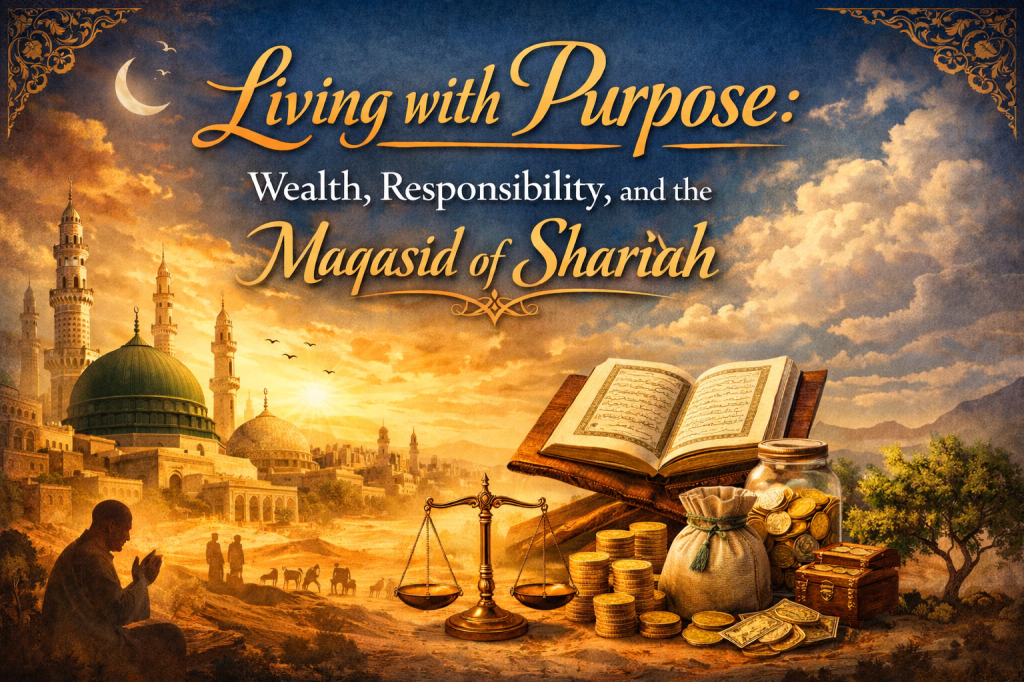
بسم الله الرحمن الرحيم
28 Shawwal 1447/17 April 2026
All praise is due to Allah, the Cherisher, Sustainer, Nourisher and Provider of the entire creation. May peace, blessings and salutations be upon our Beloved Prophet Muhammad ﷺ.
Every success, every form of richness, and all wealth possessed by a person is from the infinite blessings and favors of Almighty Allah ﷻ. A person may attribute their achievements to intelligence, effort, or opportunity, but the reality is that all of these are themselves gifts from Allah ﷻ. Health, ability, intellect, time, and circumstance are all created and facilitated by Him alone. Thus, whatever we “own” is not truly ours in an absolute sense; rather, it is a deposit and a trust (أمانة) placed in our care.
This concept of amanah fundamentally reshapes how a believer views wealth and success. It transforms ownership into responsibility, privilege into accountability, and enjoyment into a test. Wealth is not merely a means of comfort—it is a means of examination. Will it bring one closer to Allah ﷻ through gratitude and obedience, or will it become a means of heedlessness and transgression?
We will all be answerable to Allah ﷻ for the manner in which we earned our success and riches, as well as how we used and disposed of them. This accountability is not partial—it is comprehensive and precise. It encompasses both the means and the ends: how something was acquired and how it was ultimately spent.
It is mentioned in a hadith found in Sunan al-Tirmidhi 2416:
Ibn Masud (R.A) narrated that the Messenger of Allah ﷺ said:
“ لاَ تَزُولُ قَدَمَا ابْنِ آدَمَ يَوْمَ الْقِيَامَةِ مِنْ عِنْدِ رَبِّهِ حَتَّى يُسْأَلَ عَنْ خَمْسٍ عَنْ عُمْرِهِ فِيمَا أَفْنَاهُ وَعَنْ شَبَابِهِ فِيمَا أَبْلاَهُ وَمَالِهِ مِنْ أَيْنَ اكْتَسَبَهُ وَفِيمَ أَنْفَقَهُ وَمَاذَا عَمِلَ فِيمَا عَلِمَ ”
“The feet of the son of Adam shall not move from before his Lord on the Day of Judgement until he is asked about five things: about his life and what he did with it, about his youth and how he exhausted it, about his wealth—how he earned it and how he spent it—and what he did with what he knew.”
This hadith presents a powerful framework of accountability. It highlights that a person’s entire existence will be scrutinized—time, energy, knowledge, and wealth. Of particular relevance is the dual questioning regarding wealth: min ayna اكتسبه (from where it was earned) and fīma أنفقه (how it was spent). This duality establishes a critical Islamic principle: both the source and the usage of wealth must be permissible (halal) and in accordance with Shariah.
According to Imam al-Tirmidhi, the above-mentioned hadith is considered weak due to uncertainty in its chain, particularly because it is primarily transmitted through Husayn ibn Qays, who is regarded as a weak narrator. However, it is important to note that some scholars have authenticated or strengthened the meaning of this narration through supporting reports. Moreover, even when a hadith is ضعيف (weak), it is not necessarily discarded outright—especially in matters of virtues and ethical reminders.
In fact, the meanings conveyed in this hadith are firmly established through numerous authentic texts. The Qur’an and rigorously authenticated ahadith repeatedly emphasize accountability, the importance of lawful earnings, and responsible spending. Therefore, this narration serves as a compelling reminder of a reality already grounded in stronger evidences: that every aspect of our lives must align with the guidance of Shariah.
Thus, the believer is called to a life of conscious compliance—ensuring that one’s youth is not wasted in heedlessness, one’s life is not spent in vain pursuits, and one’s wealth is neither tainted by impermissible means nor squandered in prohibited avenues. This comprehensive ethical framework produces individuals who are not only spiritually aware but socially responsible.
Nobody would deny that the precepts and ordinances of any divine law (Shariah), enacted for the benefit of humanity, are intended to achieve specific goals set by Allah ﷻ. These goals are not arbitrary; rather, they reflect divine wisdom, justice, and mercy. The laws of Islam aim to cultivate moral discipline, protect human dignity, preserve societal harmony, and ensure both worldly well-being and eternal success.
Allah ﷻ reminds us in the Qur’ān (23:115):
أَفَحَسِبْتُمْ أَنَّمَا خَلَقْنَاكُمْ عَبَثًا وَأَنَّكُمْ إِلَيْنَا لَا تُرْجَعُونَ
“Did you then think that We created you in vain, and that you would not be returned to Us?”
This verse decisively negates any notion of purposeless existence. Human life is not random, nor is it without direction. Every command and prohibition within Shariah is tied to a higher objective, and every human action carries consequence.
Based on an inductive investigation (استقراء) of numerous evidences from the Qur’an and authentic Sunnah, scholars have concluded that the rules of Islamic Shariah are founded upon wisdom (حِكمة) and underlying causes (أسباب). These rulings consistently aim to secure benefit (مصلحة) and prevent harm (مفسدة) for individuals and society at large. This understanding forms the basis of what is known as the Maqasid al-Shariah—the objectives of Islamic law.
As articulated by Ibn Ashur, these objectives revolve around the preservation of essential human interests such as religion, life, intellect, lineage, and wealth. Wealth, in particular, is to be protected not only from loss but from corruption—ensuring it circulates in a just, ethical, and beneficial manner.
Therefore, when Islam regulates earning and spending, it is not merely imposing restrictions—it is nurturing a just economic order, purifying individual conduct, and safeguarding society from exploitation, inequality, and moral decay.
In light of this, the concept of wealth as an amanah becomes even more profound. It is a means through which one can fulfill obligations, uplift others, support noble causes, and earn closeness to Allah ﷻ. At the same time, it is a test that can lead to accountability and regret if misused.
May Allah ﷻ grant us the ability to recognize His favors, to utilize them in accordance with His pleasure, and to live lives that reflect the true spirit and objectives of His divine law. May He accept our efforts, overlook our shortcomings, and grant us understanding and sincerity.
References
(Ibn Ashur, 2006, p. 5) – Ibn Ashur, M. al-Tahir. (2006). Treatise on Maqasid al-Shariah (M. E.-T. El-Mesawi, Trans.; p. 5). The International Institute of Islamic Thought
 The Garden of Knowledge
Leave a comment