
بسم الله الرحمن الرحيم
24 Rajab 1446/24 January 2025
All praise is due to Allah, the Cherisher, Sustainer, Nourisher and Provider of the entire creation. May peace, blessings and salutations be upon our Beloved Prophet Muhammed ﷺ.
In last week’s article we gave an introduction to Tarim. This week we will speak about the journey and the experience.
The Journey
So before I left I never really know what to expect. I spoke to a few friends, read a few books on peoples experiences but everyone had a unique and different experience.
One of the challenges we find is that there is only one airline that goes into Yemen and that is Yemenia. Firstly the prices are quite expensive and secondly there are only 4 flights into Seiyun which is the closest airport to Tarim. 3 of those flights are from Cairo and 1 from Jeddah.
So I decided to go through Cairo and return to Jeddah. Interestingly enough there is another terminal in Cairo which is basically what some people call a ‘war terminal’ meaning the flights that leave from there usually go to countries where there was presence of war in recent times.
Now when you land in Seiyun; you land in a very small airport. People departing can see the people arriving. There’s only 1 flight out a day and one flight in.
Compared to other airports you are given a very warm welcome and reception. People are friendly and you are met with your driver that takes you to Tarim.
Normally when traveling abroad one would rely on roaming or an eSIM to have cellphone connection, this is not the case. Internet connection is not the greatest. You either buy a SIM card which gives you data but doesn’t have full coverage in all areas or you can buy a Remas card which is basically your wifi card. This allows you to connect to a max of 2 routers in and around Tarim.
The Experience
I arrived in Tarim just in time for the weekly Mawlid which takes place every Thursday in Dar ul Mustafa. What an atmosphere. Greeted all round with nothing but smiles and friendly faces. Over 2000 people in attendance and as the programme went on, mugs of water were passed around where people had 2-3 sips and passed the mug on. As the programme progressed Yemeni coffee was poured into small cups and passed to every person in attendance. Some of these traditions are not that we can understand but it is so wholesome and you can truly feel the sense brotherhood. Alhamdulilah I had few friends from South Africa that were studying at Dar ul Mustafa which made the reception even better. Habib Umar bin Hafiz mentioned that one of the wisdoms behind the weekly Mawlid was to develop and build love and connection in the hearts of people with Allah and His Rasool ﷺ and to turn the hearts of the people to ask from Allah what they want and desire.
The way I see it Mawlid is something which is supposed to take place everyday in the life of a Muslim and the people of Tarim embody this. It is remembering Allah and the greatest blessing and the greatest of creation, the Prophet Muhammed ﷺ .
Tired and hungry, I was greeted by a fellow South Africa who is studying in Tarim who invited me to his place for a home cooked meal.
The next morning I woke up excited and went for fajr prayer. Every Friday morning, Habib Umar makes his way toward the Zanbal (the local cemetery) where atleast 70 Sahaba who were of the people of badr and tons of Awliya Allah are buried. Till today we find people being buried in Zanbal and this tradition of visiting the Zanbal on every Friday morning is to encourage everyone to remember those that passed on before us.
Later I went out looking for breakfast. 11am and not one shop is open. In Tarim shopkeepers open usually at their own convenience. No one is chasing money or work. Friday mornings are all about preparing for Jumuah and connecting with Allah to which is one Jamiah Masjid in each area where the Jumuah takes place.
So for 3 days eating biscuits and water for breakfast until I found a place which sells Bakhramri and Tea immediately after Fajr. Bakhamri is a local pastry which is like what we call a ‘vetkoek’ in South Africa. Simple and perfect for a morning breakfast.
After Jumuah all guests and new comers in Tarim are invited for lunch at the House of Habib Umar. Over 100 people gather, read a portion of a book, eat a traditional lamb mandi (rice dish) and recite Qasaaid.
After asr I accompanied one of my friends to Masjid BaAlawi where Habib Umar teaches a few times a week. What an amazing experience. Learned scholars such as Habib Khadim as Saqqaf and others who are highly qualified sit at the feet of Habib Umar to learn and gain beneficial knowledge. They sit with an eagerness to drink from the knowledge of Habib Umar. In the evening after esha one of my friends introduced me to a cafe which caters to westerners where I had possible one of the best lotus cheesecakes ever.
Every morning after Fajr there is a tradition of Musafaha where everyone greets everyone. So the first row starts and shakes hands with one another forming sort of a queue while the morning athkaar was recited. Saturday morning my friend and I visited the Maqam of Nabi Allah Hud with a Shaykh Ihsaan Kolia (originally from South Africa, living in Tarim for over 10 years). It was a 2 hour journey where we stopped at the Maqam of Habib Abubakr bin Salim along the way. This is where I was introduced to bakhramri for the first time. The way the locals have it is by opening it up and placing a boiled egg with salt and pepper as a means of flavor with a cup of tea. The journey was long but memorable. Every year in the month of Sha’baan thousands of people gather at Nabi Allah Hud for 5 days to remember the Prophets of Allah. Now this may be strange to many but what used to happen is way before the advent of Islam people used to visit this particular site and used to trade and the reasons for trading in places like the area of Nabi Allah Hud (remote area 90km from Tarim) and the likes of Makkah is because they were considered sacred places. One of the scholars witnessed this and then suggested making it annual visit the Nabi Hud (A.S). Over time trade in this area stopped and the annual visit continues until this day.
Later that day I received a pass from Darul Mustafa to attend a private Mawlid (as I was a guest in town for the Winter Dowra which was to commence the following week) in the basement of Dar ul Mustafa. A gathering of intense blessing, high emotions and abundance of dua. We witnessed students that graduated the completion of the memorisation of the Quran and one of them was one who read the entire Quran in one sitting. Thereafter we witnessed something amazing. Habib Umar introduced the concept of dramas and plays as a means of entertainment and da’wah considering the times which we are in. This particular drama stirred so much of emotion in the crowd and encouraged the participants to repent and to try and be better.
The next day I took it easy and rested abit. The dowrah was starting in a few days and didn’t want to burn out. Later that evening I accompanied my friend to Masjid as Saqqaf for the Hadra as Saqqaf which is a unique dhikr known to the people of Tarim with Duff and flutes unlike the typical Hadra we are exposed to in South Africa. While they may be difference of opinion regarding this type of dhikr one can just appreciate such a gathering of remembrance of Allah with such an atmosphere beyond expectation.
Everyday presented a new experience. The people and Mashaaikh of Tarim honor the guests in a unique way. Monday afternoon we were invited to the home of Habib Muhammed Al Aydaroos (who visited South Africa in 2024). The amount of attention and time given to the guest is beyond one’s understanding. We spent the rest of the afternoon in his company. The evening came to a close with us attending Habib Umar’s weekly Tafsir class which takes place in Dar ul Mustafa.
We spent Tuesday by visiting some of the local Masaajid in the Tarim area. It is said that there are 360 Masaajid in Tarim alone. This is because there was a Masjid on every corner. As time went on, Masaajid were combined for example Masjid BaAlawi today is a combination of 4 different Masjids. Later that evening we welcomed the guests from around the world who just arrived for the Winter Dowra.
Wednesday afternoon was spent in the company of Shaykh Ihsaan Kolia and after asr we attended a gathering of the recitation of the Burdah at the home of one of the students.
Later that evening we accompanied our brother Masud to Dar al Faqi which is the institute of the late Mufti and elder brother of Habib Umar, Habib Ali al Mashur where a very advanced lesson takes place. Habib Umar’s use of the Arabic language in general is very hard to understand but this was even harder. Students of Arabic for 9-10 years could not retain or understand the content but still attended the gatherings for the sake of Barakah and with the hope of gaining some understanding.
After Esha that night we were invited to two gatherings, one in a house of a student of a South African where all the South Africans gathered to encourage and motivate one another and the second one was on the rooftop of the same building with Qasaaid and in the presence of Habib Muhammed Al Aydaroos.
Every Thursday after Fajr there is a Quran Khatam recitation in Dar ul Mustafa where small circles of 5-6 are created to recite Quran followed by a dua made by Habib Umar.
That very same morning we accompanied our friend Masud to a private class with one Shaykh Bazuyhar in the mountains and what an experience it was. The Arabic was so simple and easy to understand. It’s as if one was just drinking from a fountain of knowledge.
After Thuhr on Thursday marked the beginning of the winter dowrah where we gathered in the home of Habib Ali bin Abi Bakr. Our schedule for the next 8 days would entail Hadith class after Fajr with Habib Abdul Rahman, Seerah after Thuhr with Habib Ali bin Abi Bakr, Daily Rowha after asr with the likes of Habib Khadim and others where advice is given, Class after Maghrib with Habib Umar followed by various special visits after Esha with the Habaaib. Nights filled with Qasaaid, naseeha, food, entertainment and tea. Yes it as hectic as it sounds. The day started at 3:30 with Tahajjud and ended at 11pm-12am.
Each lesson, each class of the Winter Dowra was filled with knowledge pouring out and we all just sitting waiting to fill our cups. Everyday begins with you emptying your cup of knowledge, forgetting that you even know a little bit and refilling your cup the next day.
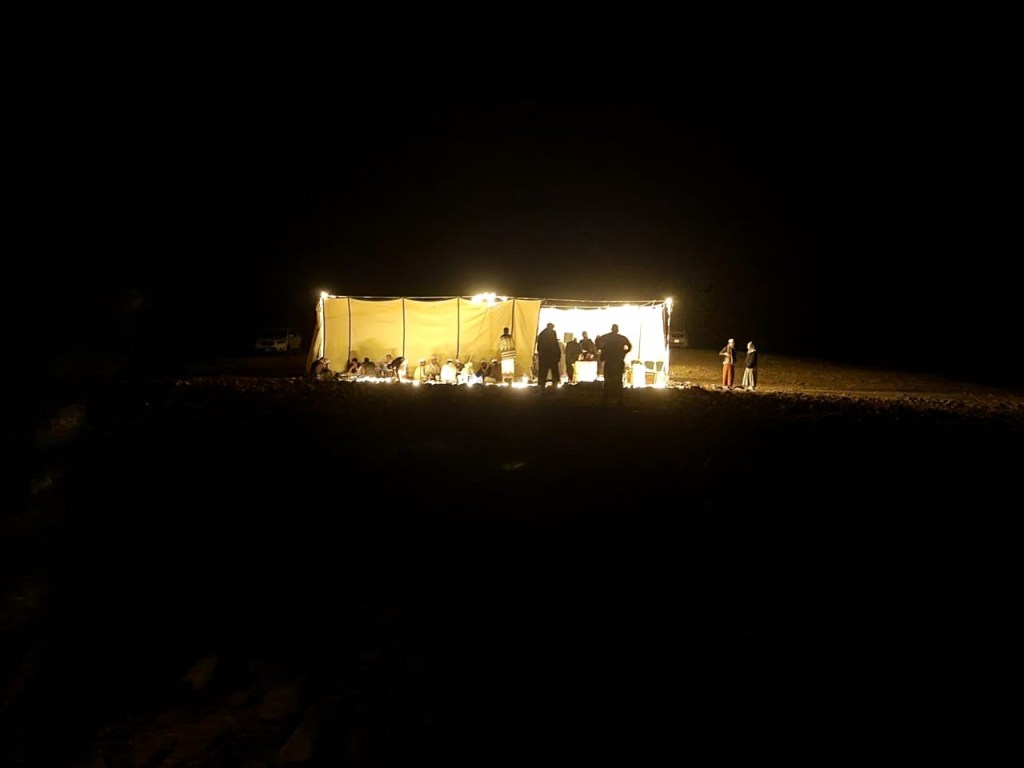
The first Friday of the dowra was an eventful evening. We all gathered on Mount Qitba. An evening under the stars with Habib Muhammed al Aydaroos and various other Mashaaikh reciting Qasaaid and enjoying a delicious meal. What made this trip even more special is that Dr Shadee ElMasry and Shaykh Murabit Benavidez from the US joined us in Tarim and added value and gems to our visits.
We were fortunate enough that we were able to witness the 1st night of Rajab in Tarim. We spent the evening at the Maqam of Nabi Allah Hud and returned around 12:30am. The rest of the night was spent in worship. It is what the locals call Ihyaa ul Layl. People gathered in the Musalla from 2am. A night which Imam Shafee is his Kitaabul Umm page 485: “ Dua is accepted on 5 nights: Night of Jumuah, Night of the 2 Eids, the first night of Rajab and the night of Nifs (15 Shabaan)”. After Fajr everyone proceeds to Masjid al Mihdar for a Mawlid programme till 8am.
As it got closer to the end of the dowra the schedule began to ease up a bit, giving a bit more room to rest. We were given a wonderful reception during our trip and an amazing farewell.
In sha Allah next we will share personal reflections and experiences from Tarim.
May Allah ﷻ accept our efforts from us and grant us understanding In Sha Allah!
 The Garden of Knowledge
Leave a comment